




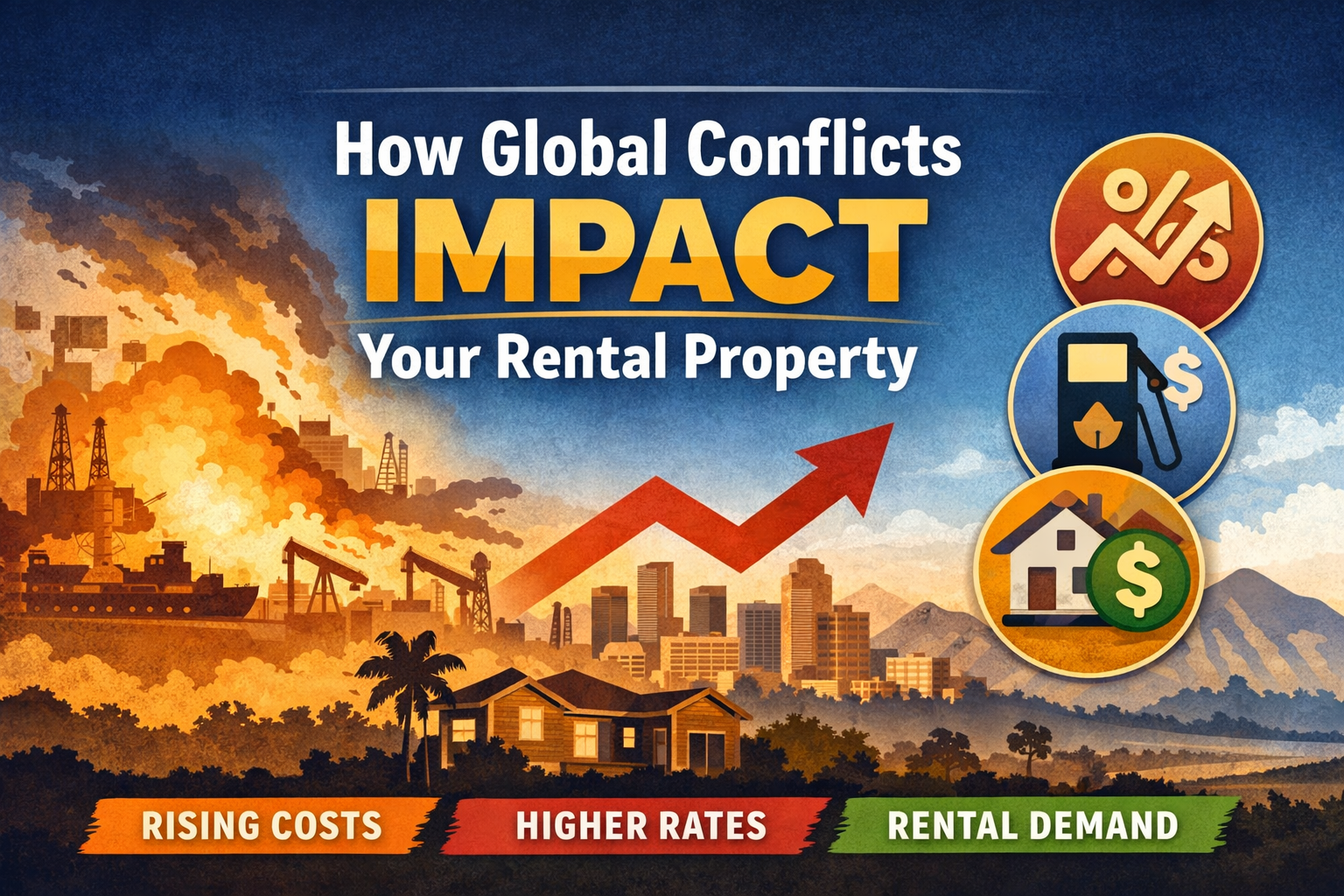
When headlines focus on conflicts in places like Iran or Venezuela, it’s easy to assume those events have little to do with your rental property.
But the reality is very different.
Global conflicts don’t just stay overseas—they ripple through the global economy and ultimately show up in places landlords feel directly: interest rates, insurance costs, maintenance expenses, and tenant demand.
If you own rental property, understanding these connections isn’t just helpful—it’s a competitive advantage.
What You’ll Learn in This Article
- How global conflicts impact interest rates and financing
- Why oil prices matter more than you think
- The effect on rental demand and tenant behavior
- How inflation impacts maintenance and operating costs
- What this means for buy vs. hold decisions
- Why long-term investors are still well-positioned
The Chain Reaction: From Global Conflict to Your Rental Property
At a high level, here’s how it works:
Conflict → Oil Prices → Inflation → Interest Rates → Housing Market → Rental Market
Let’s break that down.
1. Oil Prices: The First Domino
Conflicts involving countries like Iran or Venezuela often impact global oil supply. Even the risk of disruption can push oil prices higher.
Why does that matter to landlords?
Because oil is embedded in nearly everything:
- Transportation (contractors, vendors, deliveries)
- Building materials (plastics, roofing, insulation)
- Utilities (heating, electricity in some markets)
When oil prices rise:
- Maintenance costs increase
- Turn costs go up
- Vendor pricing becomes less predictable
This is often one of the earliest and most immediate impacts landlords feel.
2. Inflation: The Silent Pressure on Your Business
Higher oil prices tend to push inflation higher across the economy.
For landlords, inflation shows up in multiple ways:
Operating Costs Increase
- Repairs and materials cost more
- Labor becomes more expensive
- Insurance premiums rise due to higher replacement costs
Tenant Pressure Increases
- Renters are paying more for gas, food, and utilities
- Affordability becomes tighter
- Delinquencies can increase at the margins
This creates a balancing act:
- You may need to raise rents to keep up
- But tenants may have less ability to absorb increases
3. Interest Rates: The Big One
Inflation is one of the main drivers of interest rates.
When global conflicts contribute to sustained inflation, central banks are less likely to cut rates—and may even keep them higher for longer.
What This Means for Landlords
Higher Financing Costs
- New acquisitions become more expensive
- Cash flow gets tighter
- Deal margins shrink
Refinancing Becomes Less Attractive (Short-Term)
- Many investors are holding onto existing loans
- The “refi and pull cash out” strategy slows down
Cap Rates Adjust
- Higher rates typically push cap rates higher
- Property values may stabilize or decline slightly
4. The Rental Demand Effect (Often Overlooked)
Here’s where things get interesting – and often more positive.
When interest rates rise:
- Homeownership becomes less affordable
- Fewer people can qualify for mortgages
- More people remain renters
Result: Stronger Rental Demand
Even during periods of economic uncertainty:
- Well-priced rentals continue to perform
- Occupancy often remains stable
- Lease terms may even extend as tenants delay buying
This is one of the reasons rental housing has historically been resilient during uncertain times.
5. The “Lock-In Effect” Is Real
Many homeowners today are sitting on historically low mortgage rates from 2020–2021.
When rates rise due to inflation and global instability:
- Homeowners are less likely to sell
- Housing inventory remains tight
- Fewer entry-level homes hit the market
Impact on Landlords:
- More renters stay renters longer
- Demand remains steady
- Turnover may decrease
This dynamic can quietly support rental property performance even in a challenging environment.
6. Insurance Costs: A Secondary Impact
Global conflicts don’t just affect oil – they also impact broader financial markets, including insurance and reinsurance.
Combined with inflation:
- Replacement costs rise
- Risk models adjust
- Premiums increase
For landlords, this has been one of the most noticeable trends in recent years:
- Higher annual insurance renewals
- Reduced carrier options in some markets
- Increased deductibles
Even if the conflict is thousands of miles away, the cost shows up in your P&L.
7. Construction and Supply Constraints
Global instability can disrupt supply chains and increase material costs.
This often leads to:
- Slower new construction
- Delayed developments
- Reduced housing supply
Why This Matters
Less new supply can actually benefit existing landlords:
- Reduced competition
- More pricing power over time
- Stronger long-term fundamentals
8. Buy vs. Hold: How to Think in This Environment
One of the biggest questions landlords face during uncertain times:
Should I buy more, or wait?
The Key Shift in Thinking
Instead of asking:
“Will rates go down soon?”
Ask:
“Does this deal make sense at today’s rates?”
Why This Matters
If a property:
- Cash flows at current interest rates
- Is in a strong rental market
- Has long-term demand drivers
Then:
👉 It’s already a solid investment.
And if rates eventually decline?
👉 That becomes upside through refinancing.
9. Why Long-Term Investors Still Win
Global conflicts create uncertainty—but they also reinforce the value of real estate as a long-term asset.
Real Estate Advantages in Uncertain Times
- Income-producing (not just price appreciation)
- Tangible asset with intrinsic value
- Inflation-resistant over time
- Control over operations and strategy
Unlike stocks, which can react instantly and dramatically to global events, real estate tends to:
- Move more gradually
- Provide consistent income
- Offer opportunities to adjust strategy
10. What Landlords Should Do Right Now
Here are practical steps to stay ahead:
1. Underwrite Conservatively
- Assume higher expenses
- Build in margin for insurance and repairs
2. Focus on Cash Flow
- Avoid deals that only work with lower rates
- Prioritize stability over speculation
3. Monitor Rent Affordability
- Stay competitive with pricing
- Avoid overreaching
4. Optimize Operations
- Work with reliable vendors
- Stay proactive on maintenance
5. Take a Long-Term View
- Don’t overreact to short-term headlines
- Focus on fundamentals and performance
Final Thoughts: Global Events, Local Opportunity
It’s easy to feel disconnected from global conflicts—but as a landlord, you’re more connected than you might think.
The key takeaway:
👉 Global uncertainty doesn’t eliminate opportunity—it reshapes it.
Yes:
- Costs may rise
- Rates may stay elevated
- Short-term challenges may increase
But at the same time:
- Rental demand remains strong
- Supply may tighten
- Long-term fundamentals stay intact
For landlords who stay disciplined and focused on fundamentals, this environment can still be highly favorable.
About Rentals America
Rentals America is a full-service property management company serving Phoenix, Tucson, and Las Vegas. We help landlords maximize returns while simplifying the day-to-day management of their rental properties.
With transparent pricing, no long-term contracts, and a full suite of guarantees, our goal is simple: protect your investment and help it perform—no matter what the market is doing.